How to Make a Porta Potty Look Nice
Most of the improvement comes from placement and servicing, not decoration. But the decoration helps, if it is done safely.

Start with the things that are not decoration
Before anything is draped over anything, three decisions do more for how restrooms are perceived than every decorative touch combined. They are also free or nearly so.
The first is servicing. A unit serviced the morning of the event, with a fresh charge, clean surfaces and full supplies, reads as acceptable. The same unit on day three of an unrevised schedule does not, no matter what is planted around it. If you do one thing, ask the rental desk to schedule servicing immediately before guests arrive, and mid-event for anything running long.
The second is quantity. Queues are what make restrooms conspicuous. A short walk to an available unit is invisible; ten people waiting in view of the reception is not. Getting the count right is the single most effective aesthetic decision available.
The third is placement, which is worth its own section.
Placement does most of the work
The goal is close enough to be convenient, far enough to be out of the sightline of the main space, and reachable without an awkward journey.
Look for something that already screens: a hedge, a wall, a treeline, the back of a marquee, a change in level. Using existing features costs nothing and looks better than anything added. Position units so the doors face away from the main space — a row of closed doors reads far better than a row of open ones, and it gives users privacy at the moment they most want it.
Keep them slightly downwind of dining and off the main circulation route, but do not banish them. A cluster people cannot find causes worse problems than one they can see. And the path matters: a route that is firm underfoot, obvious, and lit after dark is part of the experience, particularly for guests in formal shoes.
Screening that works
When you do add screening, a few approaches are reliably effective.
Freestanding panels and lattice
Timber lattice, garden trellis, or hired event panels placed in front of and between units create a partial enclosure while leaving the doors and roofline clear. Partial is the point — full enclosure traps odour, which is exactly what you are trying to avoid. Weight the bases properly; a panel that blows into a unit is worse than no panel.
Planting and greenery
Potted plants, tall grasses, or hired planters at the ends and between units soften the outline effectively and photograph well. They also give a natural reason for the cluster to sit where it does.
Fabric and drapery
Draped fabric on a frame can look excellent, but keep it on a separate structure rather than attached to the unit, and never across the roofline. The vent stack exits at the top, and covering it defeats the entire odour-control system.
Signage
A simple, well-made sign in the event's own styling does a surprising amount. It signals that the restrooms were planned rather than parked, and it removes the awkward business of guests asking where to go.
Interior touches
The inside is where a guest actually forms an opinion, and small additions land well.
A battery LED lantern or stick-on light transforms a unit after dark and needs no wiring. A small mirror, a hook for a bag, and a lidded sanitary bin cover the practical gaps. A discreet air freshener helps, though it works with servicing rather than instead of it. Amenity baskets — tissues, sanitiser, basic supplies — are common at weddings and cost very little.
Matting or a simple runner at the door keeps grass and mud out and makes the approach feel finished. Keep anything you add clear of the door swing and out of the way of the service technician, and remember to remove it before pickup.
The safety rules that override the aesthetics
Four things must not be compromised for appearance, and event staff should know them.
Never obstruct the vent stack at the top of the unit — it is what stops the cabin smelling, and covering it is self-defeating as well as unpleasant. Never block or restrict the door swing, including with planters placed a little too close. Never block the service route, or the technician cannot reach the unit and your mid-event servicing does not happen. And never place units or screening across an exit route, exit door, fire lane, or emergency access — that is a life-safety matter with no flexibility in it.
Also keep accessible units genuinely accessible. Screening that narrows the approach or adds a step defeats the purpose of providing them, and the accessible route needs to stay firm, level and wide enough throughout.
When to upgrade instead
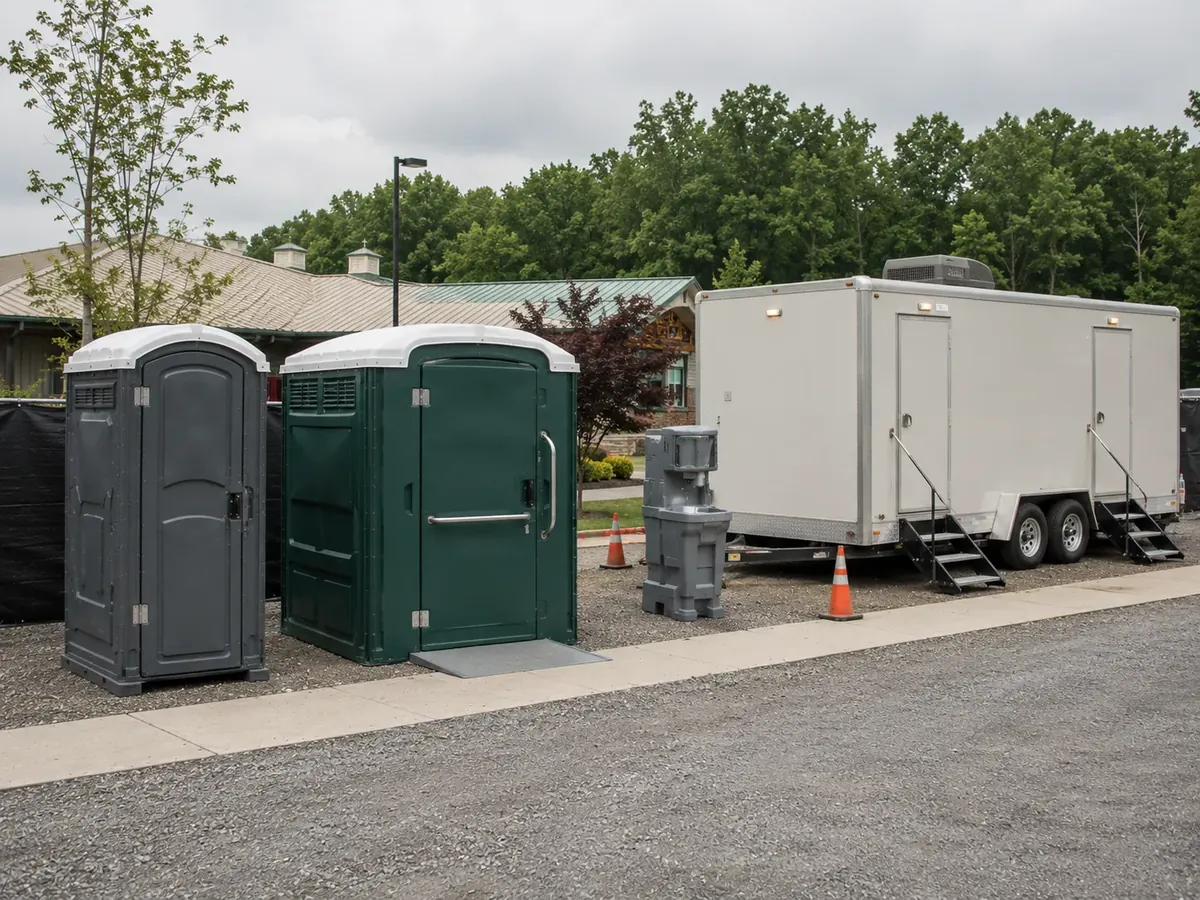
There is a point at which decorating a standard unit stops being the efficient answer. For a wedding, a corporate event, or anything where guests are dressed up and the restroom experience is part of the impression, a restroom trailer solves the problem at source: finished interiors, flushing toilets, running water, mirrors, lighting and often climate control.
Comparing unit types side by side helps here. A common and sensible pattern is a trailer for the main guest area with standard units for parking, vendors and back of house. That puts the spend where guests experience it and keeps the rest practical. Trailers do need power, water, a level pad and towing access, so confirm those early — they are the four things that most often rule a trailer out late in planning.
Frequently asked questions
Placement, servicing and quantity do most of the work. Beyond that, partial screening with lattice or planting, doors facing away from the main space, a battery light and mirror inside, matting at the door, and simple signage in the event styling all help.
Yes, with limits. Keep the vent stack at the top completely clear, do not restrict the door swing, do not block the service route, and never place units or screening across an exit route or fire lane. Attach decoration to a separate frame rather than the unit.
A row of closed doors reads much better than a row of open ones, and it gives users privacy at the moment they most want it. It is a free improvement that most people overlook.
If guests are dressed up and the restroom experience is part of the impression, usually yes. A common pattern is a trailer for the main guest area with standard units for parking and back of house. Trailers need power, water, a level pad and towing access.
Schedule servicing to land immediately before guests arrive, keep the vent stack clear, avoid fully enclosing units with screening, and place them slightly downwind of dining. Air freshener works alongside servicing, not instead of it.
Sources
Regulations change and local requirements vary. Confirm current requirements with the authority having jurisdiction for your site.
Star Portable Restrooms Editorial Team
Star Portable Restrooms publishes rental planning guides and helps customers make inquiries to local providers. Articles use the sources listed on each page; they are not accounts of equipment owned or jobs performed by Star. Confirm the equipment, price, and service plan with your rental provider.
About Star →
Check availability for your site
Call with your delivery ZIP code, dates, project type, and estimated attendance or crew size.