How Do Porta Potties Work?
There is no plumbing, no water supply, and nowhere for anything to go. Once you understand that, every rule about portable toilets makes sense.

The short version
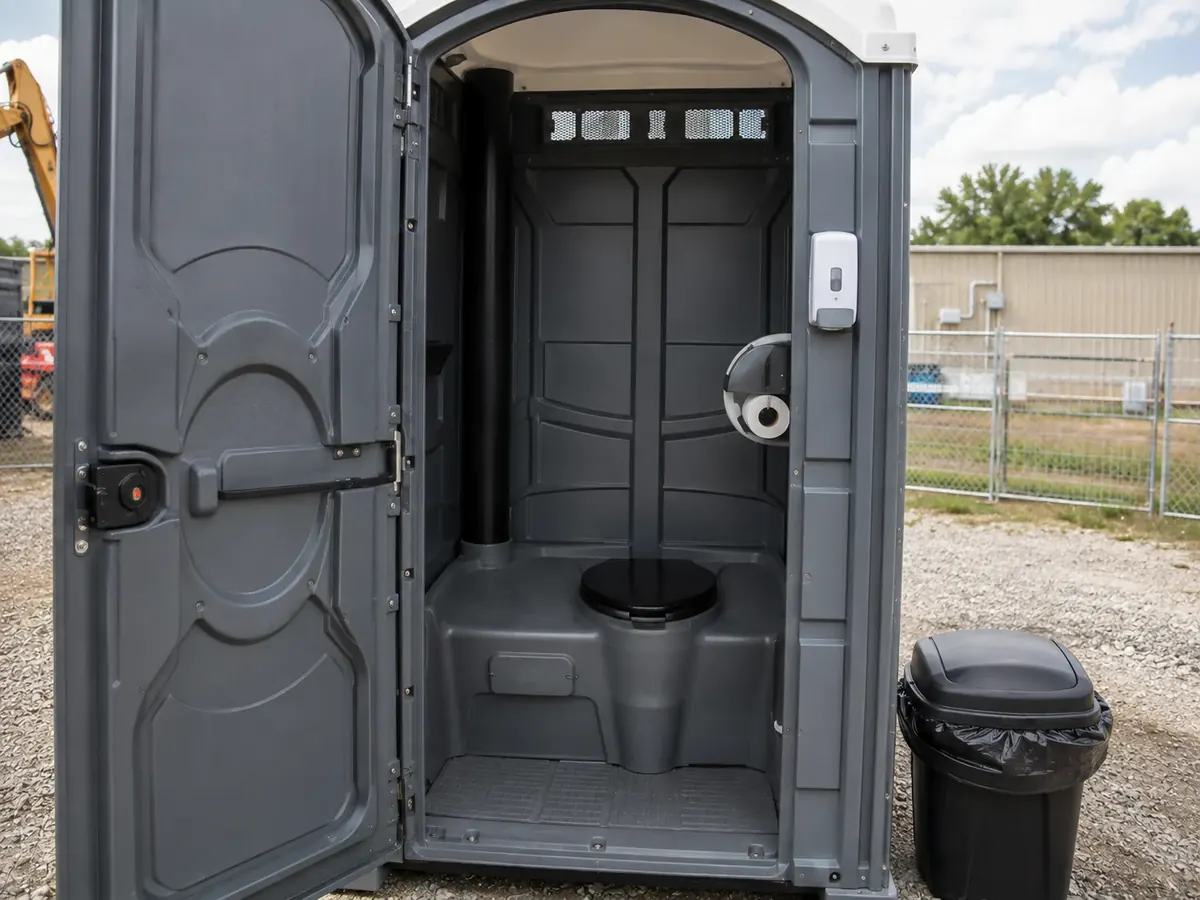
A portable toilet is a self-contained cabin sitting on top of a sealed holding tank. Nothing is plumbed in and nothing drains away. Waste falls into the tank, a chemical treatment controls odour and begins breaking down solids and paper, and everything stays there until a service truck pumps it out and hauls it to a licensed treatment facility.
That single fact — it is a container, not a connection — explains almost every rule you will ever be given about portable restrooms. Why wipes cause problems, why you should not pour chemicals in, why placement has to allow a truck to reach the unit, why service frequency matters more than unit count on a long rental. All of it follows from the tank.
The parts that do the work
A standard unit looks simple from outside, and mechanically it nearly is. There are only a handful of components, and each one exists to solve a specific problem.
The holding tank
The base of the unit is a moulded tank, typically holding somewhere around 60 gallons on a standard model. It is sealed apart from the toilet opening and the service port, and it is sized so a normal unit can absorb a full day of heavy event use, or roughly a week of light job-site use, before it needs attention.
The chemical charge
After every pump-out the tank is recharged with a measured dose of deodorising treatment and a few gallons of water. This is the blue liquid people notice. It suppresses odour-causing bacteria, masks what is in the tank visually and by smell, and helps break down solids and toilet paper so the tank pumps out cleanly.
The vent stack
Run your eye up the corner of most units and you will see a pipe from the tank to a vent at roof level. Air warmed inside the tank rises up the stack and escapes above head height, which pulls fresh air down through the cabin rather than letting tank air sit in it. It is passive, it has no moving parts, and it is the main reason a well-placed unit smells far better than people expect.
The cabin
Everything above the tank exists for the user: a self-closing door with an occupancy indicator, a ventilated but private enclosure, a non-slip floor, a paper dispenser, and on many models a urinal to keep liquid volume out of the main bowl area. Translucent roof panels light the interior in daylight without needing power.
What actually happens to the waste
This is the part most people have never thought about, and it is the reason the whole service exists.
A service technician arrives with a vacuum truck carrying a waste tank and a fresh-water tank. A suction hose goes into the service port and the tank contents are drawn out under vacuum. The empty tank is then rinsed, the interior surfaces are cleaned and disinfected, a fresh chemical charge and water go in, and consumables are restocked. On a well-run route the whole visit takes only a few minutes per unit.
The truck does not dispose of anything on site. Collected waste is hauled to an approved receiving point — usually a municipal wastewater treatment plant, sometimes a licensed septage facility — where it enters the normal treatment process. Disposal is regulated, records are kept, and this is precisely why you must never treat a rental unit as a dumping point for anything else.
Why the tank explains the rules
Once the mechanism is clear, the guidance stops feeling arbitrary.
Wipes do not break down because the treatment is designed for waste and standard toilet paper, and there is no sewer flow to carry anything away. Trash takes up tank capacity you paid for and can block the suction hose. Solvents, fuel, bleach and paint kill the treatment chemistry, can react inside a sealed space, and contaminate a load that has to be lawfully disposed of. Foreign objects damage pumping equipment and often cannot be retrieved.
Placement rules come from the same place. The unit has to sit level so the tank sits level and the vent works. It has to be reachable by a truck with a hose of finite length. And on a long rental, the service interval — not the number of units — is what determines whether capacity ever runs out.
How the other unit types differ
Accessible units use exactly the same principle in a larger shell: ground-level entry, a wider door, room to turn a wheelchair, and support rails, over the same style of holding tank.
Restroom trailers are genuinely different machines. They have flushing toilets, running-water sinks, interior lighting and often climate control, which means they need a power connection and either a water supply or a filled onboard tank. They hold fresh water and waste in separate tanks and need a level pad plus towing access. The comfort is much closer to an indoor bathroom, and so are the site requirements.
Handwashing stations are simpler than either: a fresh-water tank, a foot or hand pump, soap and towels, and a greywater tank underneath. No power, no plumbing, and they are usually planned alongside toilets rather than instead of them.
What this means when you rent one
Three practical consequences are worth carrying into a rental conversation.
First, capacity is finite and refills on a schedule, so the honest answer about crew size and event length matters more than getting the lowest quote. Second, the placement you choose is also the placement a truck has to reach every service visit, not just on delivery day. Third, how people use the unit has a direct effect on how well the service schedule holds — a single bag of site rubbish in the tank can cost a working unit for days.
None of this is complicated. It is a tank, a treatment, a vent, and a truck. Plan around those four things and portable sanitation is one of the more predictable parts of running a site or an event.
Frequently asked questions
It stays in a sealed holding tank underneath the unit until a vacuum truck pumps it out. The truck then hauls it to an approved receiving point, usually a municipal wastewater treatment plant or a licensed septage facility, where it enters the normal treatment process.
Standard units need neither. They are self-contained, with a holding tank and a passive vent stack. Restroom trailers are different — most need a power connection and either a water supply or a filled onboard tank.
Two things work together: a chemical treatment in the tank that suppresses odour-causing bacteria, and a vent stack that carries tank air up above head height so fresh air is drawn down through the cabin instead.
It depends entirely on usage. A standard tank absorbs roughly a day of heavy event use or about a week of light job-site use. Service frequency is set from crew size, attendance, and rental length rather than a default.
A tank can fill if usage runs well beyond what the service schedule assumed. That is why being accurate about crew size and event length matters — it is the input that sets the service interval.
Sources
Regulations change and local requirements vary. Confirm current requirements with the authority having jurisdiction for your site.
Star Portable Restrooms Editorial Team
Star Portable Restrooms publishes rental planning guides and helps customers make inquiries to local providers. Articles use the sources listed on each page; they are not accounts of equipment owned or jobs performed by Star. Confirm the equipment, price, and service plan with your rental provider.
About Star →Check availability for your site
Call with your delivery ZIP code, dates, project type, and estimated attendance or crew size.